A sense of an integrated body
The most characteristic effect. You stop feeling yourself in parts and the body registers again as one continuous whole.
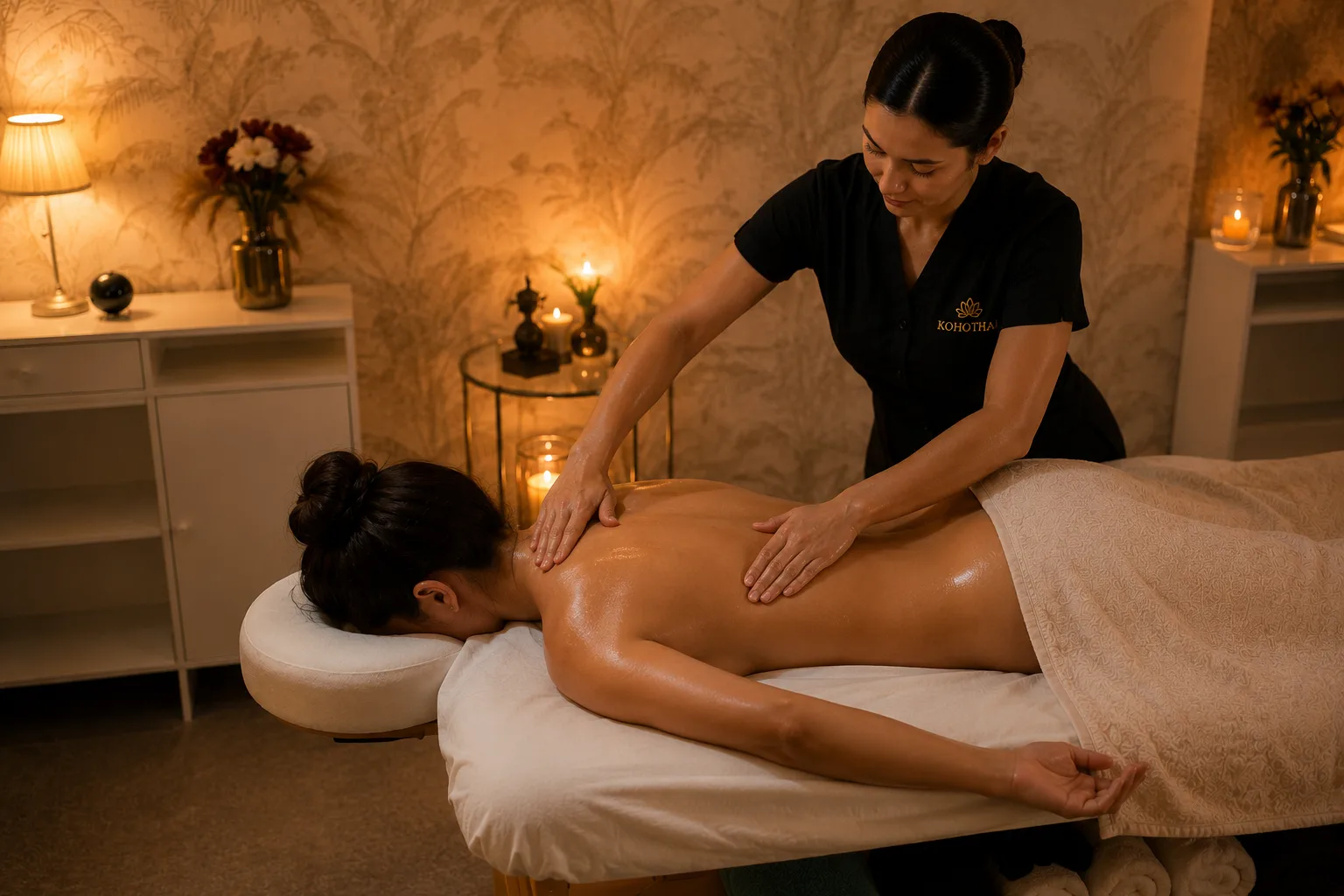
Long strokes travelling from feet to head without ever breaking contact. It doesn't work area by area; it works the body as a single piece. It's the treatment most people describe as reconciling: it doesn't remove a specific pain, it resettles something harder to name.
It emerged in 1970s Esalen, California, among therapists and psychologists.
It came out of the holistic centres of the Californian coast, in a setting where body work and emotional experience were explored together. That's where its signature comes from: continuity. The hands never leave the body, and the journey isn't broken into parts.
That continuity has a specific purpose. With no interruptions, the body stops perceiving itself in pieces — this back, this leg — and reassembles as a whole. It's an effect that's hard to convey in writing and unmistakable once experienced.
The most characteristic effect. You stop feeling yourself in parts and the body registers again as one continuous whole.
Some tension doesn't come from bad posture but from holding on for a long time. This massage works precisely there.
Long strokes toward the heart support venous return across the whole body rather than area by area.
It's the treatment most booked during grief, life changes or emotional exhaustion.
This is an enveloping, full-body massage, always within a professional framework: you stay covered with towels except for the area being worked, underwear stays on, and you can indicate areas you'd prefer excluded at any point.
Price per person. Individual session in a private room.
It means its purpose isn't to treat an injury but to accompany a state. Continuous, unbroken contact has a calming effect on the nervous system, and some people experience it as emotional relief. It is a professional body massage, not psychological therapy.
It happens, and there's nothing strange about it. The body holds tension from difficult periods and sometimes lets go when it fully relaxes. The therapist is used to it: the session isn't interrupted and no comment is made unless you want one.
We work with oil on the skin. You stay covered with towels throughout except for the specific area being massaged, and underwear stays on. You can say at the start which areas you'd rather weren't touched, and it's respected without questions.
Kohorelax works area by area with enveloping strokes and aims at switching off. The Californian doesn't fragment: it travels the whole body continuously, and its intention is bodily integration rather than rest. If you simply want to relax, choose Kohorelax.
It needs the full circuit, so 60 minutes (€80) is the reasonable minimum and 90 minutes (€110) the ideal. In 30 minutes there isn't time to complete the journey and the point of the technique is lost.
Yes, the pressure is gentle. But if prolonged contact feels uncomfortable to you, or you'd rather start with something more contained, Kohorelax is a more neutral entry point.