Faster recovery after effort
Supports the clearing of metabolic by-products that build up in training and shortens the time until you're back at full capacity.

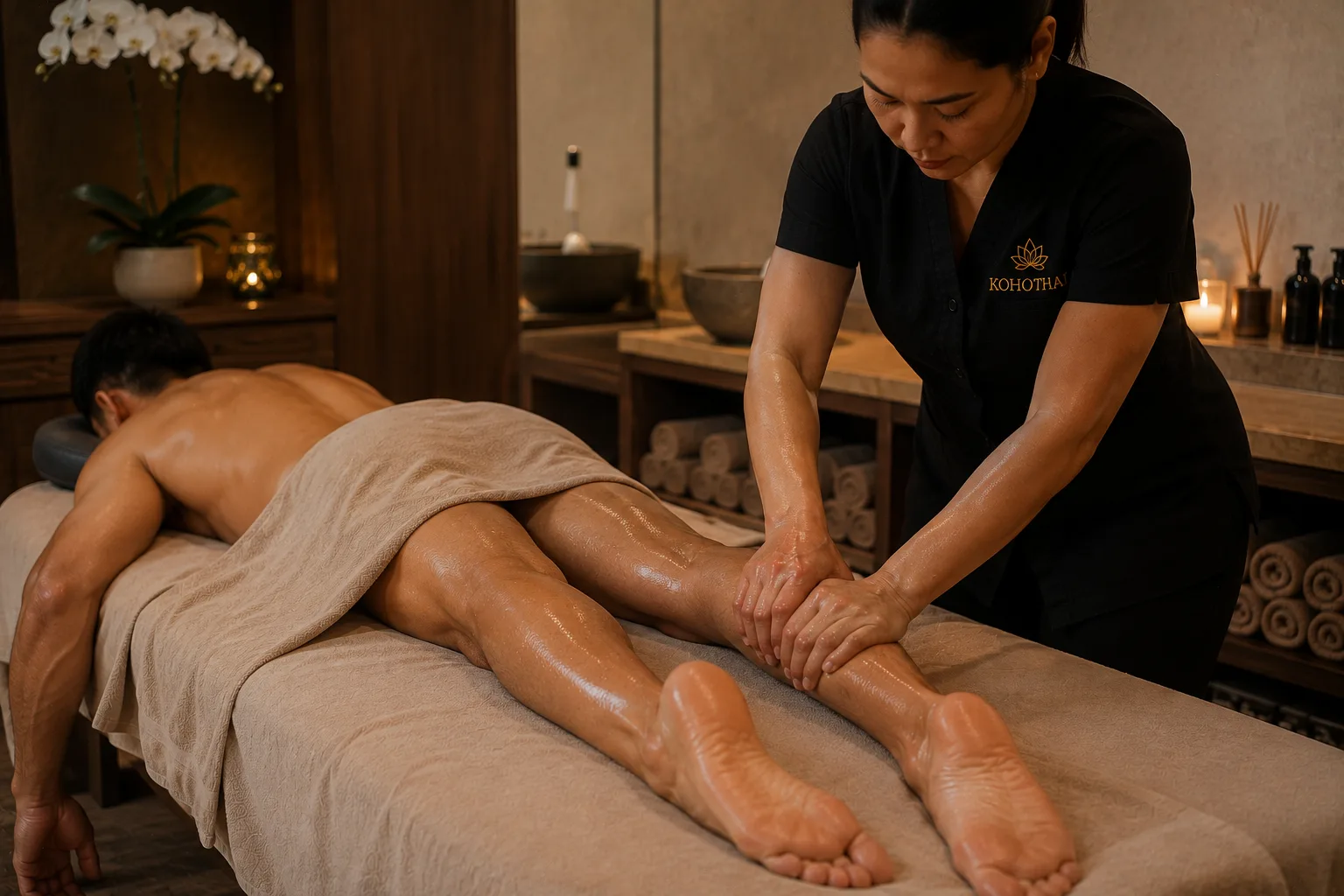
For before or after, depending on what you need. Brisk friction, percussion and stretching that prime the muscles if you're competing, or speed up recovery if you've just trained hard. It restores elasticity and prevents the injury that hasn't happened yet.
It isn't a stronger massage: it's a massage with a different goal.
Sports massage was formalised in the twentieth century alongside sports medicine, and its logic differs from ordinary therapeutic massage: it doesn't aim to relax, it aims to restore performance. That's why the rhythm is brisk and stimulating where other massages are slow.
It works on two fronts. Before effort, it raises blood flow and muscle temperature so the body responds better. Afterwards, it supports the clearing of exercise by-products and restores length to fibres left shortened.
Supports the clearing of metabolic by-products that build up in training and shortens the time until you're back at full capacity.
Finding and releasing a loaded area before it tears is the difference between one massage session and six weeks on the sidelines.
The most common reason runners and cyclists come. Calves, hamstrings and quads regain elasticity and the heaviness disappears.
Restoring length to shortened fibres improves your stride, your squat and any movement that has quietly been getting shorter.
This does not replace a physiotherapist or a medical diagnosis. With a recent injury, the first step is always a healthcare professional.
Price per person. Individual session in a private room.
It depends on the goal. Before an event, 24 to 48 hours ahead, with a stimulating rhythm and no deep work: the aim is to arrive loose, not sore. Afterwards, wait 24 to 72 hours for inflammation to settle, and then deeper work is possible.
Yes. Many people book it because they work standing, carry weight or spend hours driving. The overload pattern in legs and lower back is very similar to a runner's.
It helps it pass sooner and eases the heaviness, but it won't remove it instantly. If you arrive very sore, pressure will be lighter than usual — the muscle is already sensitised.
30 minutes (€50) for legs only, the most requested option among runners. 60 minutes (€80) for legs and back. 90 minutes (€110) for full work after a long race.
If you train several times a week, every 2 or 3 weeks works well as maintenance. In competition season, one flushing session after each big effort.
After a light activating session, yes. After deep flushing work, better to leave 24 hours: muscle is temporarily less responsive and performance drops.